How to Launch a Crypto Trading Platform in 2026: Build an Exchange, Build a Front End, or Go White-Label?
Three realistic ways to launch a crypto or DeFi trading platform in 2026: build your own exchange, build a front end on existing protocols, or start from a white-label terminal. What each takes, how front ends earn, and the legal questions to ask first.
 Vincent Inferido··10 min read
Research-based, not legal or financial advice · prices and features checked on official sources on . See sources
On this page
A founder messages me: "We want our own trading platform. Like the big ones. Perps, yield, lending, everything."
It's a great goal. It's also the moment where a lot of crypto projects quietly burn a year and most of their budget, because "our own trading platform" can mean three very different things. One of them needs a team of protocol engineers, auditors and lawyers. The other two can be live in weeks.
In this guide I break down the three realistic ways to launch a crypto trading platform in 2026, what each one really takes, how front ends actually earn money, and the legal questions to answer before you write a line of code. At the end you can click through Tidewell Terminal, a trading terminal I designed and built to show what the finished product looks like.
Quick picks: which path fits you?
The 30-second comparison
| Build your own exchange | Front end on existing protocols | White-label terminal | |
|---|---|---|---|
| What you build | Smart contracts, matching engine, oracles, liquidity, interface | The interface plus integrations | Branding plus integrations |
| Who holds user funds | Your contracts (or you) | The user's own wallet and the protocol | Depends on the backend you connect |
| Time to first launch | Many months to years | Weeks to a few months | Weeks |
| Main risks | Security, liquidity, regulation | Protocol dependency, regulation | Fit with your backend |
| How it earns | Trading fees | Builder fees, partner programs, subscriptions | Your own business model |
Time frames are typical ranges for planning, not quotes. Every project is different.
The 3 paths, reviewed
Path 1: Build your own exchange
Own everything, including every risk.
- Best for
- Well-funded teams with protocol engineers, security budget and legal counsel from day one.
- Pricing
- The most expensive path by far: protocol engineering, multiple security audits, market-making and liquidity, infrastructure, and ongoing compliance.
- Watch out for
- A new exchange with no liquidity is an empty room. Wide spreads push traders straight back to the big venues.
- Full control of markets, fees, matching and the roadmap
- Every trading fee is yours
- A real moat if you succeed
- Smart contract bugs can lose user funds permanently
- You must attract liquidity before anyone wants to trade
- The heaviest legal and regulatory load of the three
Verdict: Only if building an exchange is your company. For most teams, it's the slowest and riskiest way to get a trading product in front of users.
Path 2: Build a front end on existing protocols
Your product, their settlement.
- Best for
- Startups, communities and wallet teams that want a branded trading, yield or lending experience without running an exchange.
- Pricing
- Mainly the interface and integration work. Protocols like Hyperliquid and dYdX offer builder codes, so a front end can earn a fee on the trades it routes.
- Watch out for
- You depend on the protocols you connect to, and you still need legal advice about who you serve and where.
- Non-custodial: users trade from their own wallets and sign every transaction
- Deep liquidity from day one, because the protocol already has it
- Built-in ways to earn, such as builder fees on routed trades
- You don't control the protocol's markets, fees or uptime
- Protocol changes can require updates on your side
- Geographic restrictions still apply to your users
Verdict: The sweet spot for most teams. You ship a real product in weeks and spend your budget on the experience, not on rebuilding an exchange.
Path 3: Start from a white-label terminal
The screen is done. Plug in your backend.
- Best for
- Exchanges, fintechs, wallet companies and protocols that already have users or a backend and need a professional trading interface.
- Pricing
- Branding, integration and any custom features, usually far less than designing a terminal from scratch.
- Watch out for
- Make sure the terminal can connect to your data and order flow, and that you own or license the code on clear terms.
- Trading, portfolio, risk and account screens already designed and working
- Brand, colors and domain are yours
- Can pair with Path 2 to go live without a backend of your own
- Customizing deeply still takes engineering time
- You need a clear agreement on code ownership and maintenance
Verdict: The fastest route when you already know your backend. It's also a safe way to test the product with real users before a bigger build.
How a front end actually makes money
This is the part most founders don't know: you can earn from a trading product without running an exchange.
- Hyperliquid builder codes. A front end can attach a builder fee to the orders it sends. Each user approves a maximum fee once by signing with their wallet. The docs cap builder fees at 0.1% on perps and 1% on spot, and the builder account needs at least 100 USDC in perps.
- dYdX builder codes and partner revenue share. Builder codes let any developer attach a payout address and a fee to orders routed through the API. The fee is paid on-chain when the trade fills. dYdX also runs a governance-approved Partner Revenue Share program for longer-term partners.
- Your own model on top. Examples: premium analytics, alerts, copy-trading tools, or a subscription for pro features.
What goes into a real trading front end
Whichever path you choose, these are the building blocks your users will expect:
- Wallet connection. MetaMask, Rabby, WalletConnect and others, with clear network switching.
- Live market data. Prices, order book, recent trades and candles that update in real time.
- An order ticket that prevents mistakes. Leverage, size, estimated liquidation price and fees shown before the user signs.
- Portfolio and risk. Positions, margin used, health factor and alerts when a position gets close to liquidation.
- Yield and lending. Supply and borrow through a lending protocol such as Aave, which offers React and TypeScript SDKs. Vault products can follow the ERC-4626 tokenized vault standard.
- Guardrails. Region restrictions where required, clear risk disclosures and terms, and a test-network mode for safe practice.
See one in action: Tidewell Terminal
To show what the finished experience looks like, I designed and built Tidewell Terminal, a working DeFi trading terminal. It combines perps, vault strategies, lending and a live risk panel in one screen.
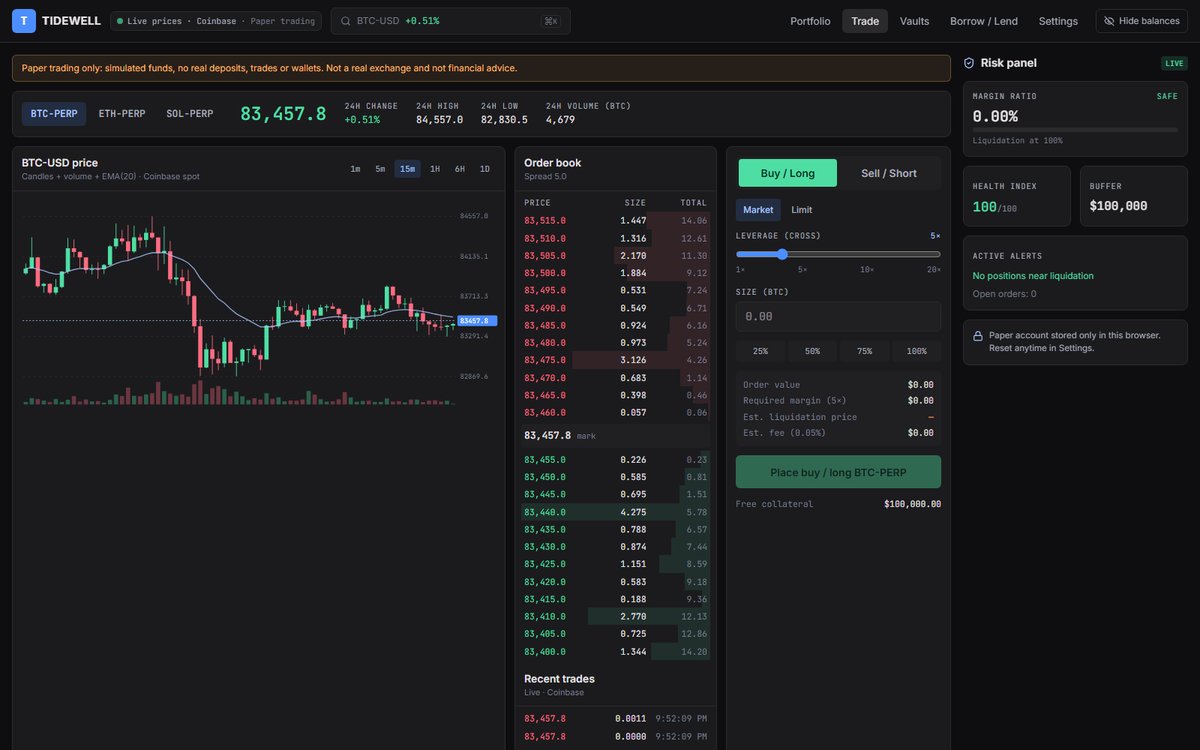
What it does today:
- Real market data. Live prices, order books, trades and candles from Coinbase's public API, with a backup source.
- Paper trading. $100,000 of pretend money to practice market and limit orders with 1–20× leverage, with liquidation estimates and fees.
- A risk panel on every page. Margin ratio, health index and alerts before a position gets into trouble, plus a "what if the price drops" simulator.
- Vaults and lending. Deposit into strategies, supply and borrow stablecoins, and watch the health factor change.
- Fully rebrandable. Change the name, logo and colors in Settings and share your branded version by link.
It's paper trading only: no wallets, no real orders, no real money. That's what makes it safe to show anyone. For a real launch, the same interface connects to wallets and to live protocols (Path 2), or to your own backend (Path 3). That's the build I offer.
Questions to answer before you build
- Who will your users be, and where are they? This drives which regions you must restrict and which rules apply.
- Custodial or non-custodial? Holding user funds changes everything, from security to licensing. Non-custodial front ends avoid holding funds entirely.
- Which protocols or backend? Pick for liquidity, reliability and developer tools, not hype.
- How will you earn? Builder fees, partnerships, subscriptions, or a mix.
- What's the smallest useful launch? Often it's read-only portfolio tracking, then test-network trading, then mainnet.
FAQ
Do I need to build my own exchange to launch a crypto trading platform?
No. Most teams build a front end on existing protocols instead. Users trade from their own wallets, the protocol settles trades and provides liquidity, and you own the interface and the brand.
How do DeFi front ends make money?
Common ways are builder fees on the trades they route (Hyperliquid and dYdX both offer builder codes), partner revenue programs, and premium features or subscriptions on top.
What is a builder code on Hyperliquid?
It's a way for a front end to earn a fee on orders it sends. Each user approves a maximum builder fee by signing with their wallet. Hyperliquid's docs cap builder fees at 0.1% for perps and 1% for spot.
Is a non-custodial front end legal everywhere?
Not necessarily. Leveraged derivatives like perpetual futures are restricted in several countries, including the United States, and many front ends block those regions. Get advice from a qualified lawyer for your target markets.
What is a white-label trading terminal?
It's a ready-made trading interface (trading, portfolio, risk and account screens) that you brand as your own and connect to your chosen protocols or backend.
How long does it take to launch a trading front end?
A focused front end on existing protocols can reach a first release in weeks to a few months, often in stages: read-only portfolio first, then test-network trading, then mainnet after legal and security review.
The bottom line
- Building an exchange is your whole company? Path 1, with serious funding, audits and counsel.
- Want a branded trading product without holding user funds? Path 2, a front end on proven protocols.
- Already have users or a backend and need the screen? Path 3, a white-label terminal.
Most teams don't need to rebuild an exchange. They need a trading experience their users trust, that shows risk clearly and that's live while the market still cares.
Planning a trading, wallet or DeFi product? Try the Tidewell Terminal demo, then send me a message about what you want to launch. You can also estimate your project in under a minute, or see how I build dashboards for SaaS and Web3 teams.
Sources
Facts were checked on these official pages on September 29, 2026:
- Hyperliquid docs: Builder codes
- dYdX docs: Builder codes
- dYdX: Introducing Partner Revenue Share on dYdX
- Aave developer documentation
- ERC-4626: Tokenized Vaults standard
- Coinbase Exchange public market data API (used by the Tidewell demo)
- Tidewell Terminal live demo (paper trading, live prices)